
A few thoughts on Van Gogh, Hodler and a Cabriolet...

If I ever crossed paths with Erin from MyArtBroker and she asked me, "If you could own any painting in the world, which one would it be?", I already know exactly what I'd answer:
Blick ins Unendliche (View into Infinity) by Ferdinand Hodler.

From the moment I first set eyes on it at KunstMuseum Basel (KMB), I have been obsessed. I even have a print of it at home. The subject, the colours, the shapes, the SIZE! It completely took my breath away.
So, naturally, any excuse to go to the Kunst is a good one when it means getting to see my favourite ladies in blue again.
Which is probably why, when I was looking for a spot for our monthly BASC art meet-up, I was drawn to Van Gogh, Hodler and a Cabriolet. The exhibition had just opened, and its description mentioned that it centred on the collection of a female Swiss collector, Gertrud Dübi-Müller. Our meet-up was going to be all about introducing new collectors to the art world. What a coincidence!
So last Saturday, I met up with some members of our BASC community at the Kunst, with no expectations beyond having some nice chats and seeing some nice art.
I've been to my fair share of exhibitions, but this one stayed with me in a way I wasn't expecting. I couldn't not write about it.
If I had to sum it up in one sentence, it would be:
"I've never seen great art look so accessible before."
Let me explain.
Who was Gertrud?
First, you need to know who we're talking about, because Gertrud Dübi-Müller (1888–1980) is not your average art collector.
She grew up in Solothurn and lost her parents as a child, which made her financially independent very young. She first came into contact with art through painting lessons with Cuno Amiet. And then, barely of age, she bought a Van Gogh. According to the curator, that purchase caused quite a stir among her friends. I can only imagine…
But she was so much more than her collection. She was a photographer. She was a mountaineer. She took zeppelin flights and travelled across Europe and all the way to North Africa, camera in hand. And, since you're probably wondering where the cabriolet in the title comes from: she was the first woman in her canton to drive her own car. There are photographs of her at the wheel in 1911.
A woman doing exactly what she wanted, on her own terms, I mean, ICONIC.
A collection that feels lived-in
The beauty of this curation is how human it feels. Every piece has a story. Every piece has a reason for being there. And most importantly, every piece feels loved.
Curator Géraldine Meyer did a beautiful job of making Gertrud's collection feel lived-in.
What struck me most was the inclusion of photographs showing the art works in the context of her own life and home. Suddenly, these weren't simply a Bailly, a Van Gogh, a Hodler or a Cézanne. They were paintings that lived somewhere. They hung on walls. They existed alongside furniture, people, everyday life and other artworks.
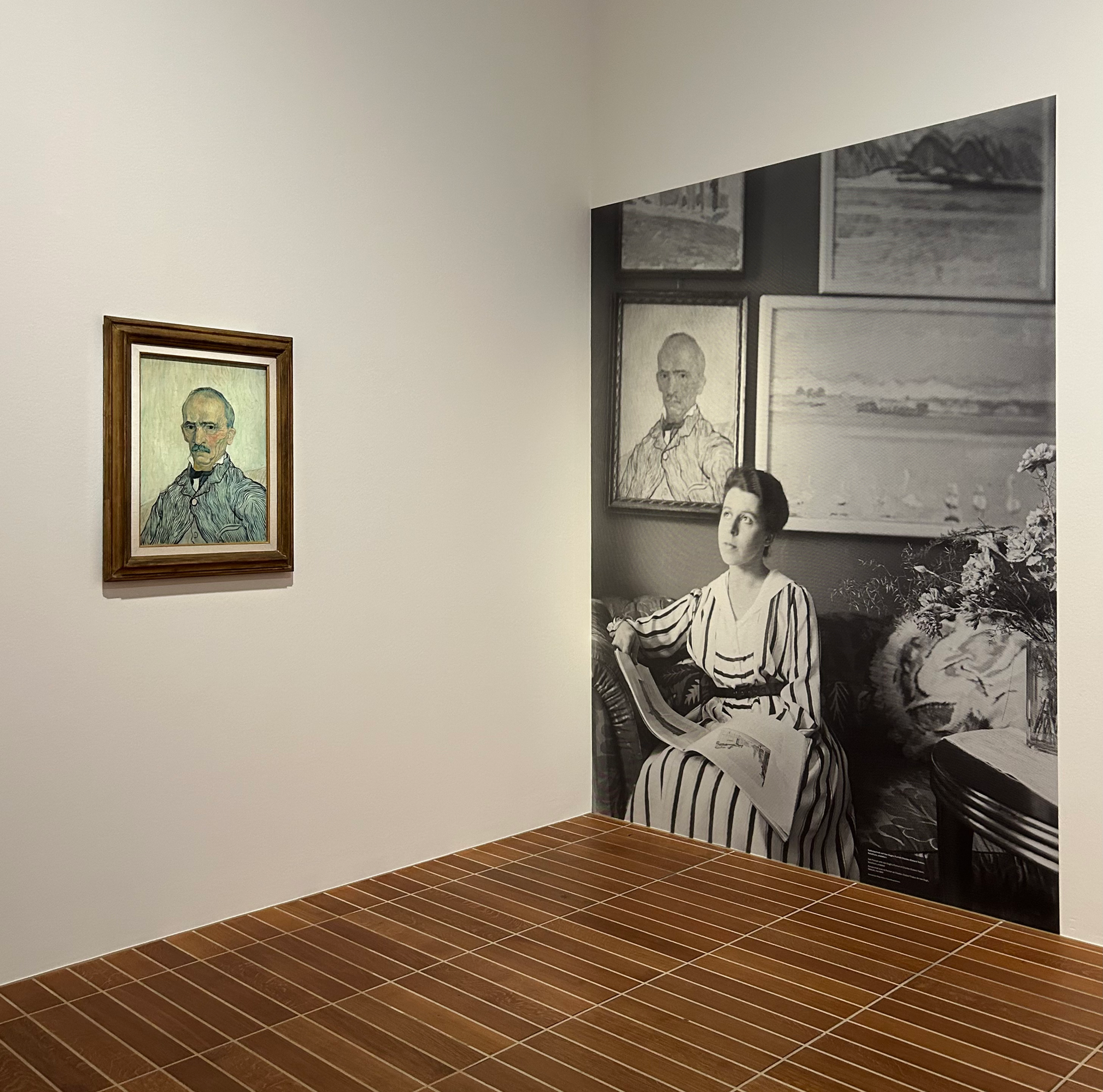
It wasn't a Van Gogh. It was a beautiful painting hanging in someone's home.
It wasn't a Klimt. It was a painting occupying a corner of a wall.
Somehow, seeing the pieces this way made them feel incredibly normal. No intimidating gallery walls, no elaborate displays separating you from the work. Just paintings that someone had chosen, lived with and loved.
More than an owner: a friend
As someone who spends a lot of time thinking about collecting, this is what interested me most. Gertrud didn't simply own art. She knew the artists, she photographed them, she supported them, she travelled to see them, she bought their work directly from them, she became friends with them and, in some cases, she became part of the work itself.
This show brings us into the world of these artists through HER camera. There are photographs of these artists in their cities, in the countryside, working, relaxing, posing and simply existing. She photographed them not only as famous artists, but as her friends.
And the relationship went both ways : Hodler painted her (seventeen times, in fact) while she photographed him. She was simultaneously his model, his friend and his collector. The exhibition makes this exchange feel incredibly intimate: while he was looking at her through his paintings, she was looking back at him through her camera.

There is something wonderfully playful about these relationships, too. In 1907, Cuno Amiet and Giovanni Giacometti both painted the 19-year-old Gertrud, using the same purple hat as their subject. What started as a portrait became a friendly artistic competition. The two paintings hang side by side in the exhibition, and you can almost feel the artists trying to outdo one another.
Then Hodler saw them. His response? A full-length portrait of Gertrud.
Suddenly, what could have been a simple collection of portraits becomes something much more interesting: a little network of friendship, competition, admiration and artistic exchange.
Collecting before the big names were big names
What surprised me most is that she wasn't simply collecting artists we now recognise as some of the great names of modern art. She was meeting them, supporting them and buying their work while many of them were still developing their careers.
Her first art purchases were two watercolours by Giovanni Giacometti in 1907, when she was just nineteen. A year later, at twenty, she bought Van Gogh's Portrait de Charles-Elzéard Trabuc ( see pic. 2 ).
Although most of the names in this story are men: Hodler, Amiet, Giacometti, I also loved discovering that one of Gertrud's closest friendships was with a woman artist, Alice Bailly.
Gertrud supported her, collected her work, building up a group of Bailly's pieces over time. This is exactly the kind of collecting I keep talking about: backing an artist because you believe in her, not because the market has already told you to.
This is where the exhibition becomes particularly relevant to my work. When we talk about collecting today, it can feel like we're talking about an exclusive club. Big names. Big galleries. Big budgets. Big white walls
Gertrud's story is a reminder that collecting can also start with curiosity, with friendship, with supporting an artist whose work you believe in, with finding a piece that speaks to you and deciding you want to live with it. The exhibition doesn't just show you a collection, it shows you a relationship with art.
And then, the twist
The show ends with studies for View into Infinity. My View into Infinity.
The painting I've been obsessed with since I first saw it at KMB.
Well, it turns out Gertrud was one of the five women who posed for it.
I mean… COME ON.
Suddenly, one of my favourite paintings has a completely different story. I had always seen it as this huge, almost otherworldly Hodler. Now I was standing there thinking: Gertrud was there. She was literally part of it.
What a 'full circle' moment.
There’s no good way to wrap this up, because I could keep on going for days, but all I’ll say is if you've ever wondered whether collecting is "for you", this exhibition might be the best answer I've seen. And if you'd like to explore it with us, come and join our next BASC meet-up : )
Tay xx


Comments